

Einstein Lectures 2026
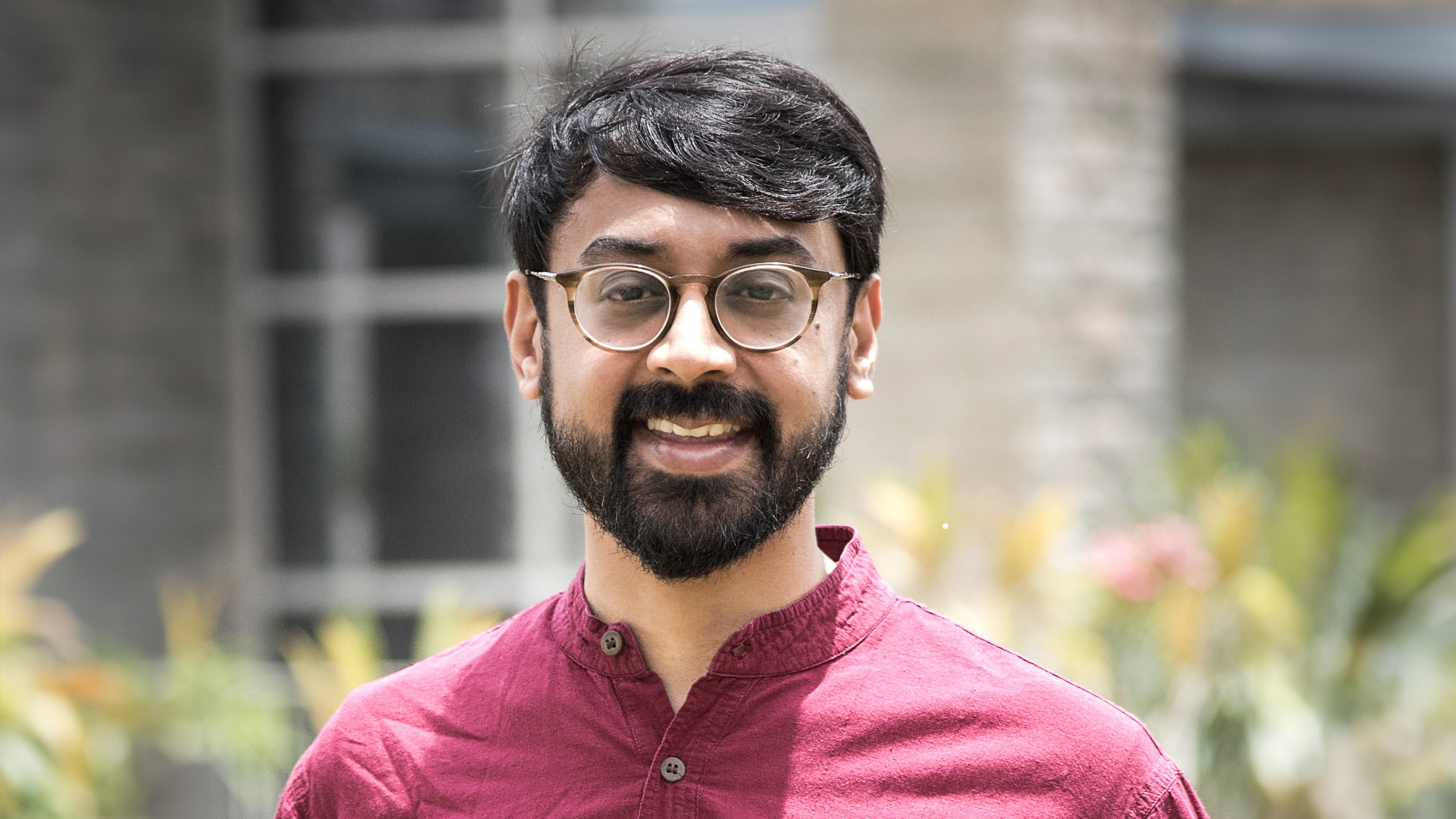
Manjul Bhargava will deliver the 2026 Einstein Lectures. Spread over three evenings, the Fields Medalist will explore a range of topics, from magical numbers and squares to millennia-old mathematical ideas, as well as current issues in number theory and the connections between mathematics, poetry, and rhythm:
Lecture 1: Monday, 19. October 2026, 7:30 p.m. - 142'857: A Magical Number Everyone Should Know
Lecture 2: Tuesday, 20. October 2026, 5:15 p.m. - Magic Squares, Cubes, and Hypercubes: From Ancient Origins to Recent Advances
Lecture 3: Wednesday, 21. October 2026, 7:30 p.m. - Poetry, Drumming, and Mathematics: The Shared Creativity of Rhyme, Rhythm and Reason
About the person
Manjul Bhargava is one of the leading mathematicians of his generation. He is the R. Brandon Fradd Professor of Mathematics at Princeton University and one of the defining figures in modern number theory. Since February 2026, he has been the first President of the National Museum of Mathematics (MoMath) in New York.
Lectures 2026
Lecture 1, Monday, 19.10.2026: 142'857: A Magical Number Everyone Should Know
We will explore the surprising magic hidden inside the number 142,857. This number exhibits a host of truly astonishing properties — some familiar, others delightfully unexpected — and sits at the crossroads of number theory, magic, and illusion. We will discuss why this number is so special, how to create others like it, and what it means to “classify” such magical numbers. Along the way, we’ll be led to the very frontier of mathematics, where these curiosities connect to one of the greatest mathematical mysteries of our time: the Riemann Hypothesis.
Lecture 2, Tuesday, 20.10.2026: Magic Squares, Cubes, and Hypercubes: From Ancient Origins to Recent Advances
Inscribed on a wall near the entrance of the majestic Parshvanath Jain Temple in Khajuraho (built around 960 CE) is a 4 × 4 magic square with remarkable arithmetic properties. We will explain why this magic square is the unique one of its kind, up to certain transformations. This answers a question posed by the legendary geometer HSM Coxeter in 1938. We will also explain why there is a unique such magic object in every dimension.
Lecture 3, Wednesday, 21.10.2026: Poetry, Drumming, and Mathematics: The Shared Creativity of Rhyme, Rhythm and Reason
Mathematics pervades all the sciences, but it also lies at the heart of a number of fields in the humanities. Two such important subjects which go back to ancient times are linguistics and music. In fact, many of the modern mathematical tools used in probability and combinatorics, and tools applied in varied technologies, such as those on NASA space missions, originate in problems encountered by linguists and musicians thousands of years ago. A look at some of these ancient, poetic problems - and their remarkable solutions through the ages – reveals much about the nature of human thought and the origins of mathematics.